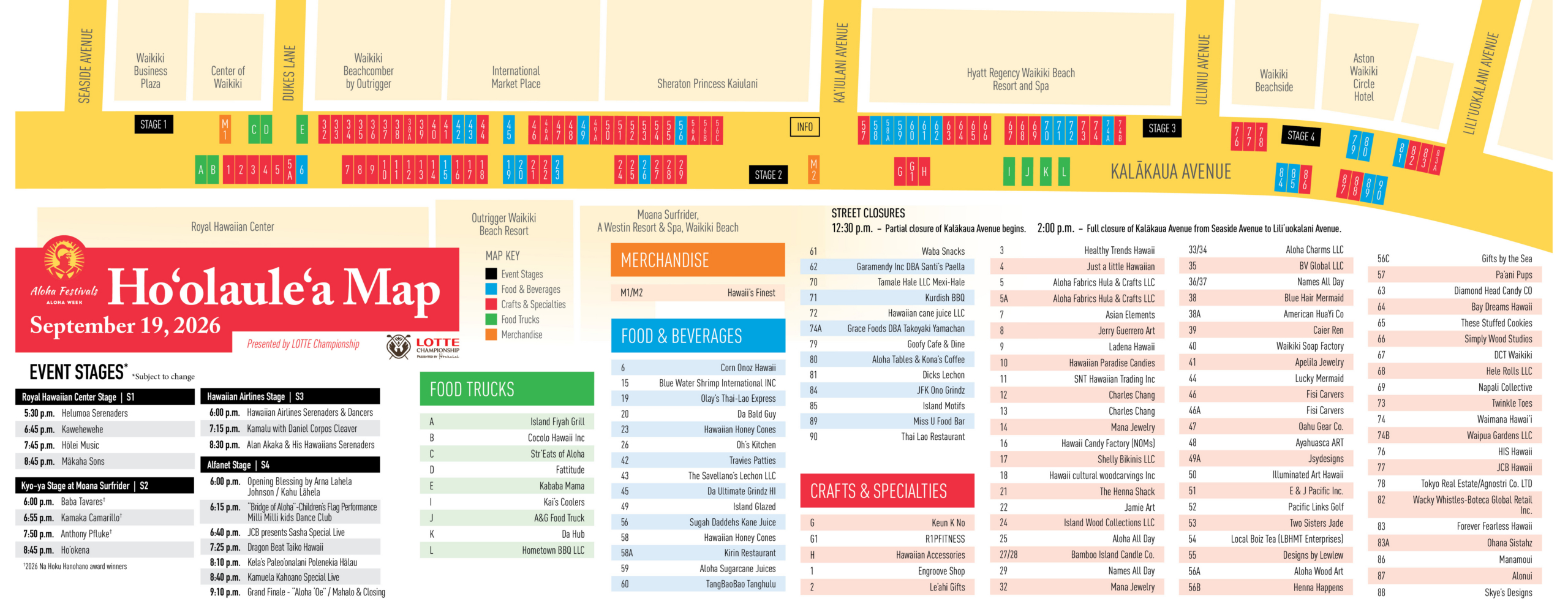
The 2026 map for the Waikīkī Hoʻolauleʻa is up, and the line on it that matters most to anyone staying here is not a set time. It is the closure box: Kalākaua Avenue starts closing at 12:30 p.m. this Saturday, Sept. 19, and the full closure between Seaside and Liliʻuokalani avenues starts at 2 p.m. — three and a half hours before the first act. Our base above Waikiki Beach Walk sits a couple of blocks Ewa of that line, so for us the whole day comes down to which side of Seaside Avenue to be on, and when.
What happened
Aloha State Daily’s weekend guide, published Sept. 16 by Katie Helland, is what put this weekend back in front of us. It lists the Hoʻolauleʻa as free, with vendors and food trucks, and reports — citing permits filed with the Department of Transportation Services for the City and County of Honolulu — that the event “is expected to bring more than 10,000 participants to Waikīkī.”
The bigger change is on the festival’s own site. Its Hoʻolauleʻa page now reads “Please see below for the 2026 vendor map” and links a map headed “Hoʻolauleʻa Map, September 19, 2026”. When we wrote about the three Aloha Festivals Saturdays two weeks ago, the only footprint map the site linked was dated Sept. 20, 2025, and we told readers not to assume last year’s closure times would repeat. They did repeat: the two times and the two cross streets we quoted from that 2025 map are the same ones on this year’s. The new map’s street-closure box reads “12:30 p.m. – Partial closure of Kalākaua Avenue begins” and “2:00 p.m. – Full closure of Kalākaua Avenue from Seaside Avenue to Liliʻuokalani Avenue.”
The map also carries this year’s stage schedule, printed with an asterisk and the words “Subject to change”: four stages strung along the avenue, the earliest music at 5:30 p.m. at the Royal Hawaiian Center stage, the other three starting at 6, and the two best-known names — the Mākaha Sons at the Royal Hawaiian Center end, Hoʻokena at the Moana Surfrider stage — both going on at 8:45 p.m. No time later than 9:10 p.m. appears anywhere on the map: the last line of the stage schedule is a 9:10 p.m. grand finale, “Aloha ʻOe,” and closing. The event page adds that vendors “will be open from 4 p.m.”
What it changes for a Waikiki stay
| Time (HST), Sat. Sept. 19 | What |
|---|---|
| 12:30 p.m. | Partial closure of Kalākaua Avenue begins |
| 2 p.m. | Full closure, Seaside Avenue to Liliʻuokalani Avenue |
| 4 p.m. | Booths and food trucks open |
| 5:30 p.m. | First music, Royal Hawaiian Center stage |
| 6 p.m. | The other three stages start |
| 8:45 p.m. | Mākaha Sons (Royal Hawaiian Center stage) and Hoʻokena (Moana Surfrider stage) |
| 9:10 p.m. | Finale and closing |
The landmarks the map prints along that same stretch give its practical size. Royal Hawaiian Center sits at the Ewa end, then the Waikiki Beachcomber; a little farther along, International Market Place and the Outrigger Waikiki Beach Resort face each other across the avenue, and so do the Sheraton Princess Kaiulani and the Moana Surfrider; past them the Hyatt Regency, and near the Diamond Head end the Aston Waikiki Circle. If your hotel’s front door opens onto that stretch, the festival does not spell out what that means for your ride — but a full closure is a full closure, so plan on a taxi, rideshare or rental car reaching a cross street rather than the door from 2 p.m. on, and on the restaurants along the avenue being busy for hours.
One block mauka, Kūhiō Avenue is not in the box. That is where the drugstore-and-groceries part of a Waikiki day lives anyway — the Target at 2345 Kūhiō Ave, listed at 8 a.m. to 11 p.m. daily when we read its store page on Sept. 16, for the week of Sept. 15–21 that covers this Saturday — so a Saturday supply run never has to touch Kalākaua.
Nothing on the festival’s pages says anything about TheBus or the Waikiki Trolley. We would not build a Saturday afternoon around either one running its normal Kalākaua route.
What we would do — and what we would skip
We have not been to a Hoʻolauleʻa, so take the crowd notes as reported rather than field-tested. What we would do is shaped by the clock more than the lineup.
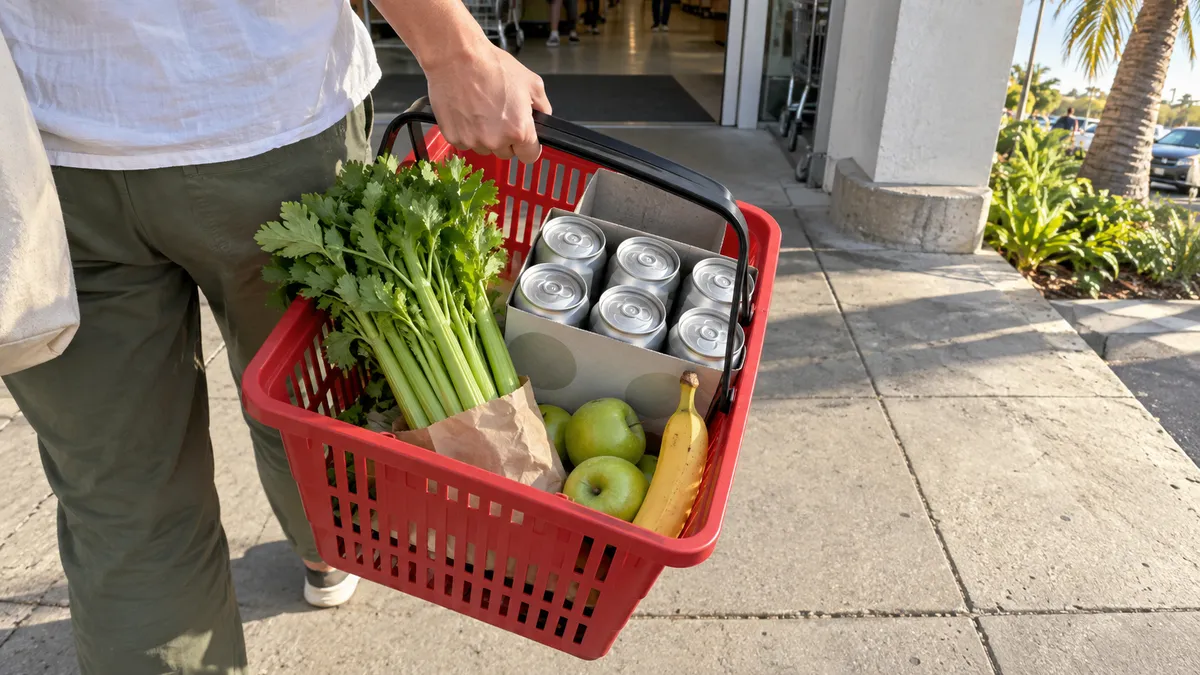
Errands before noon. Beer, fruit, whatever else the room needs, bought on Kūhiō while the avenue is still an avenue. If the week’s grocery run were going to Ala Moana Center, we would go early and be back by one o’clock rather than find out the hard way what the closure does to the trolley.
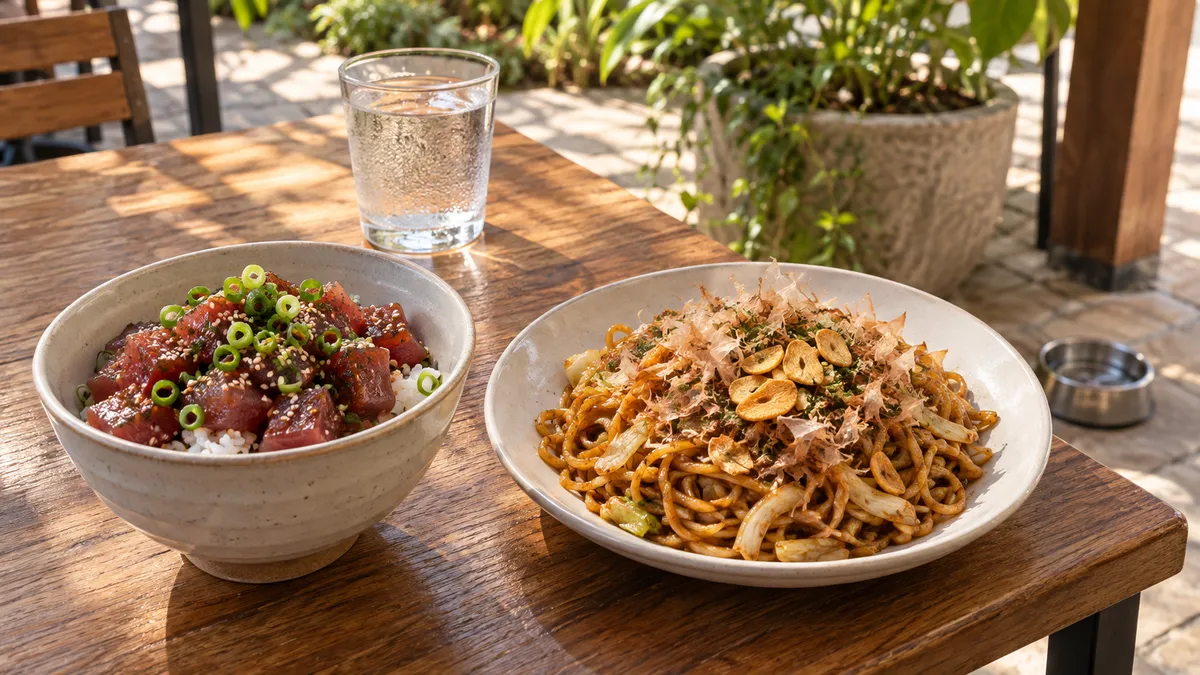
One walk at 4, not at 8. The booths open at 4 and the first stage does not start until 5:30, which is the quietest ninety minutes that street will have all evening. We would walk in from the Seaside end, buy one plate of something, and be back on the Waikiki Beach Walk side before 6 — without counting on a bar stool at the end of it. The bar happy hour at Ruth’s Chris does run 4 to 7 every day, but it is bar only, no reservations, and our own rule there is to be in by about 3:45; showing up at 5:30 is a gamble on an ordinary weekday, let alone with a street festival two blocks away. So it is one or the other: sit down at 3:45 and skip the walk, or take the walk and let dinner be takeout in the room, which is where our evenings were always going to end.
If the headliners are the point, do the opposite. Come at 8, and pick one of the two 8:45 p.m. sets in advance: they run at the same hour on different stages, several blocks apart, so you are choosing between them rather than catching both. Book dinner somewhere off Kalākaua that night, or eat before you go.
If you rented a car, leave it parked. The partial closure starts at 12:30 p.m., which is before most people would think to move a car, and none of the pages or the map we checked give a reopening time.
The other big one that night is not in Waikiki. Aloha State Daily also lists Chinatown 808’s Mid-Autumn Festival on the same Saturday, with a parade, a lantern-making workshop and contest, and more than 30 food or craft vendors. Chinatown sits outside the range we actually use on these trips — Waikiki on foot plus Ala Moana Center — so we are not going to plan a night there we would not take. If you have a car, or do not mind the bus, it is the alternative to the crush on Kalākaua.
Before you plan around this
We read three things on Sept. 17, 2026 — the Hoʻolauleʻa event page, the festival’s events index and the 2026 map — and the stage schedule on the map carries its own “subject to change” note.
Two things the official pages still do not settle. The events index lists the Hoʻolauleʻa as “Saturday, Sept. 19, 2026 | 6 – 9:30 p.m.,” while the event page says 6 to 10 p.m. The map’s 9:10 p.m. finale leans toward the earlier of the two, but a finale time is not a reopening time, and none of those three says when Kalākaua reopens. If you have a table booked on that stretch, or a ride to catch afterward, look for city traffic advisories before Saturday rather than trusting the festival’s end time.
The attendance number is worth reading for what it is, too. The “more than 10,000 participants” line is not a festival announcement and not a reporter’s estimate: Aloha State Daily attributes it to permits filed with the city’s Department of Transportation Services — an expectation written into the paperwork for closing the street, not a headcount. The festival’s own pages do not print a crowd figure anywhere we looked.
Details
- Footprint: Kalākaua Avenue, Seaside Avenue to Liliʻuokalani Avenue, per the 2026 map.
- Admission: the event page lists none, and Aloha State Daily calls the Hoʻolauleʻa free.
- Re-verify times at alohafestivals.com/waikiki-hoolaulea.