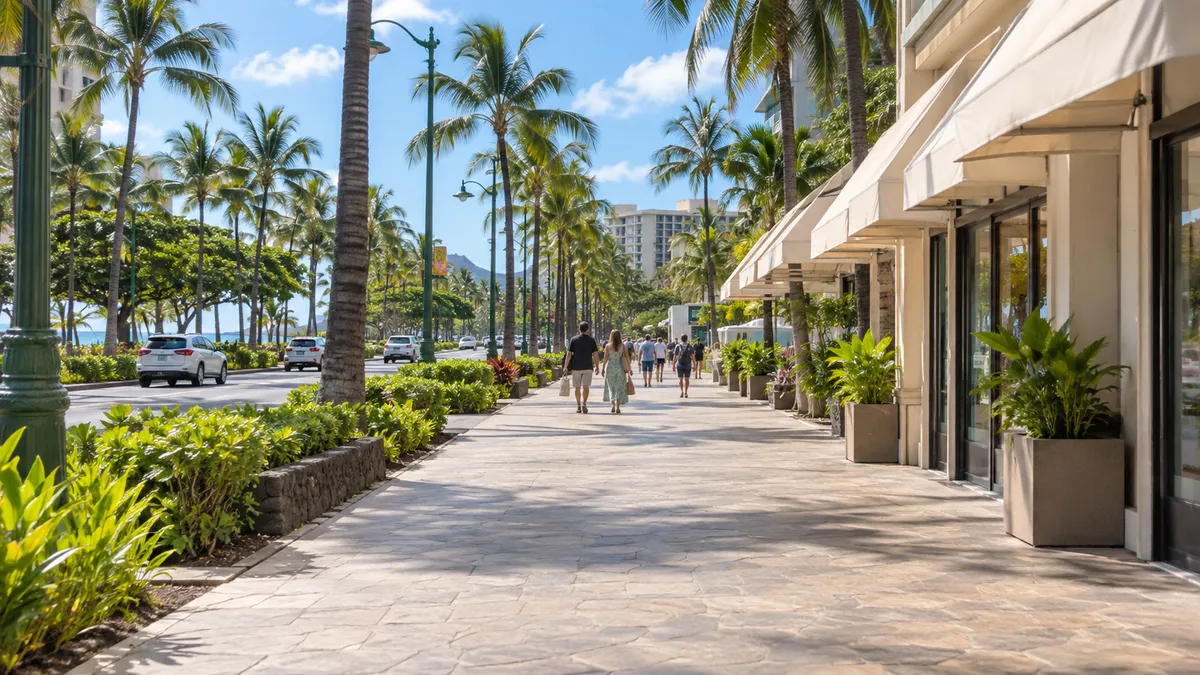
A folding table on Kalākaua Avenue could get a lot more expensive to run. Honolulu’s Bill 52 would raise the fine for breaking the city’s peddling rules in public places from $100 to $500 for a first offense, and the City Council pushed it forward on Sept. 9. We walk that stretch most days of a stay, carrying groceries back from a short list of stores, and buy essentially nothing on the street itself — so our first question was not about the sellers, but about whether the sidewalk gets any easier to walk.
What happened
The Council voted unanimously on Sept. 9 to pass Bill 52 on the second of its three readings, the Honolulu Star-Advertiser reported in a Sept. 18 story by Ian Bauer. Council Chair Tommy Waters, whose District 4 includes Waikiki, introduced the measure in July. It covers peddling on city-owned streets, sidewalks, malls and other public areas, and the bill itself states that steeper fines will discourage illegal peddling and ensure adequate pedestrian access.
Honolulu bills take three readings, so one vote remains. The Star-Advertiser said more committee review was expected first; the Council’s bill page shows the International and Legal Affairs Committee reported it out for passage on third reading on Sept. 24. Aloha State Daily reported on Sept. 12 that the bill went to the International and Legal Affairs Committee after the Sept. 9 vote, and that three council members — Augie Tulba, Andria Tupola and Matt Weyer — voted yes with reservations.
Most of the testimony in both stories comes from one side of the question. Honolulu Police Maj. Paul Okamoto told the Council that visitors walking Kalākaua and Kūhiō avenues pass a gauntlet of peddlers competing for their attention, and that current penalties are treated by many operators as “a cost of doing business.” David Erdman, interim president and CEO of the Retail Merchants of Hawaii, argued that a fine small enough to absorb is not a deterrent at all, since a cited seller can pay it and go back to the same spot. Aloha State Daily carries a third voice the Star-Advertiser does not: John Mark Mageo of ABC Stores, who called illegal kiosks “a real hardship” for businesses that follow the city’s rules.
What it changes for a Waikiki stay
The fine schedule is most of the bill, but not all of the penalty: the bill text keeps up to 30 days in jail as an option, but only for a third violation within two years. The first-offense fine goes up fivefold, the second-offense fine triples, and the top of the third-offense range does not move at all — what changes there is the floor.
| Offense | Now | Under Bill 52 |
|---|---|---|
| First | $100 | $500 |
| Second (within 2 years) | $250 | $750 |
| Third or more | $500–$1,000 | $1,000 |
Where selling is banned outright is the part most visitors never see written down. City code bars peddling in certain areas even for sellers who are licensed or exempt. Aloha State Daily lists some of them: Pali Highway, Diamond Head Road, Fort Street Mall, Union Street Mall, Waimea Bay, Chinatown and the Waikīkī Peninsula — which reads like a list of places visitors end up. The code’s full list is longer and also covers city parks and beaches.
A license doesn’t open Waikiki. The city code sets a peddler’s license at $60 a year and exempts sellers of fresh fish, fruit, lei, flowers or vegetables and people 60 or older; Aloha State Daily reports that the city licenses 49 peddlers. But the same article of the code makes peddling on Waikiki’s public streets, sidewalks, parks and beaches unlawful even for someone who is licensed or exempt. On Kalākaua, a $60 license is not a way around a $500 fine.
Both stories describe fines on the seller; neither mentions any penalty for the person buying. We are reading news coverage, not the ordinance text.
The enforcement numbers the Council asked about
Before voting, members asked how much of the existing law is being enforced. The police department’s figures, per Aloha State Daily, are these: 50 people fined in 2023, 15 in 2024, 68 in 2025. That is not a trend line: down about 70 percent, then more than quadrupled. Neither story explains the swing, and a number that jumps like that is hard to read as a straight count of how many tables were out.
Council member Tyler Dos Santos-Tam put the problem plainly, per the Star-Advertiser: “Because if it’s not being enforced at all, raising the fines may not end up deterring these folks anyway.” Vice Chair Andria Tupola said she wanted to see how many citations had been issued in her own district. Waters thanked them and the bill moved forward anyway. Both members said they planned to contact the police department for more information, per Aloha State Daily.
What we would do — and what we would not
Nothing about our week changes, and we want to be honest about why: we were never the customer here. We do not rent a car, so everything gets carried. Beer comes from Longs a minute or two from the door, the bigger grocery run is about fifteen minutes on foot to Waikiki Market, and the Target on Kūhiō Avenue covers most of the rest. A folding table on the avenue has never been part of that list.
What we would actually notice is the other half of the bill’s stated purpose — adequate pedestrian access. Walking back at two in the afternoon with a few cans and a bag of fruit, a blocked sidewalk means swinging out toward the curb to get around it: small, and annoying every single time. But peddlers are one of several reasons a Waikiki sidewalk narrows; construction fencing, sandwich boards and people stopping for photos do plenty of it too. We would not plan a trip around the sidewalk being clearer in six months.
If you do buy from a street setup, the practical risk is not the ordinance — it is that a tour or a “deal” sold off a table has no counter to go back to on day four. Our answer stays boring: buy it from a store with a door.
Before you plan around this
Bill 52 is not law. It passed the second of three readings on Sept. 9, 2026. The new fine amounts are what the bill proposes, checked Sept. 19, 2026; the current fines and the $60 license fee are in city code today. The committee reported it out for third reading on Sept. 24 (checked Sept. 26), and no date for the final vote was posted. The Council’s public bill browser at hnldoc.ehawaii.gov lists measures by year and is where the current status will show up.
Know which numbers come from where. The vote and the Okamoto and Erdman testimony are from the Star-Advertiser’s Sept. 18 report; the fine amounts and the jail provision are also in the bill text. The ABC Stores testimony, the 49 licenses and the year-by-year enforcement figures are from Aloha State Daily’s Sept. 12 report. The $60 fee and the Waikiki ban are in the Revised Ordinances of Honolulu, Chapter 13, Article 6 (§13-6.1 and §13-6.2), checked Sept. 26, 2026.
Your regular stops are not the target. The rules are about selling on public streets, sidewalks, parks and beaches; stores and restaurants run on different rules.
This is our reading of a bill still in progress as of September 2026, not legal advice.