If you are in Waikiki on Monday, Nov. 2, every outdoor warning siren in the state is going to sound for one minute at 11:45 a.m. It is the regular monthly test, not an emergency, and nobody is asking you to go anywhere. We don’t eat lunch on our trips, so late morning is usually suite time for us, windows open, which is exactly when a sound like this comes straight in. Here is what it is and what we do about it: almost nothing.
What happened
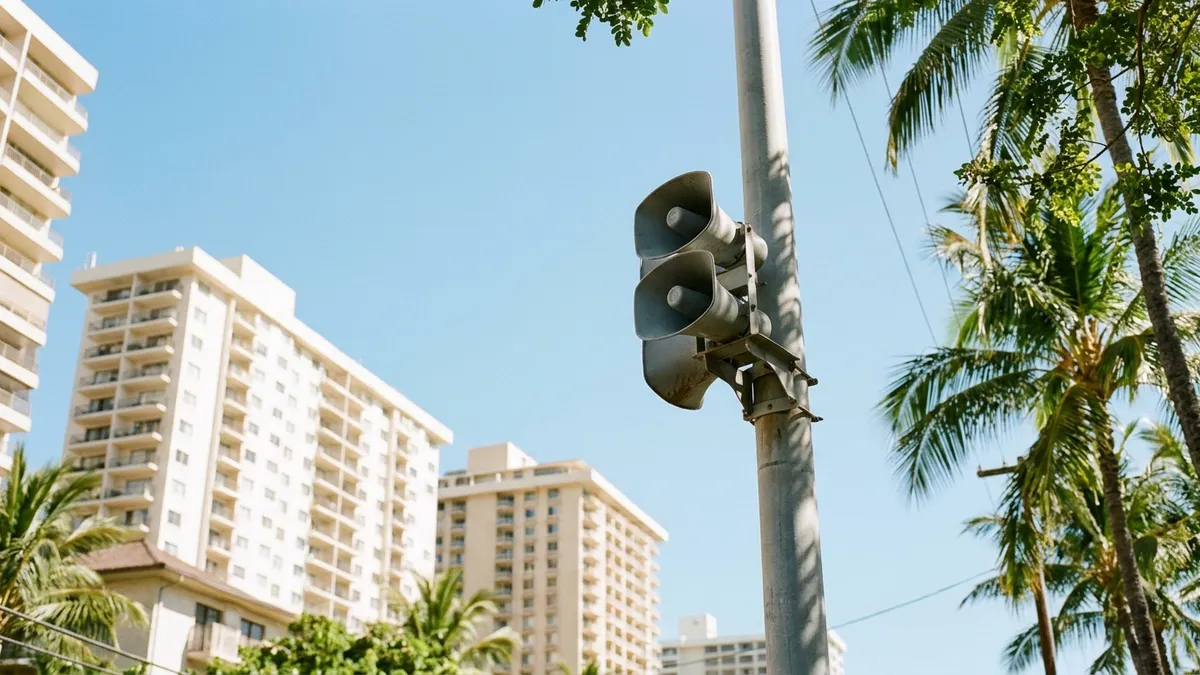
Big Island Now reported on Oct. 30 that Hawaii’s all-hazard outdoor warning sirens will sound statewide at 11:45 a.m. on Monday, Nov. 2, as a one-minute attention alert signal. The test runs alongside a live audio broadcast segment of the Emergency Alert System, and the report says there will be no exercise or drill with it.
This is not a one-off. The Hawaii Emergency Management Agency’s siren page says all sirens are tested statewide “on the first business day of the month at approximately 11:45 a.m.,” together with the Emergency Alert System. Nov. 1 falls on a Sunday this year, so Monday is the day. The same page describes Hawaii’s network as “the largest single integrated outdoor siren warning system for public safety in the world.”
As for the sound itself, Big Island Now’s August preview of the same monthly test described the attention alert signal as a “steady tone.” So: one long, even note for about a minute, not a rising-and-falling wail.
What it changes for a Waikiki stay
Practically, nothing changes. Here is the whole thing in one place, as reported for Monday:
| Item | Monday’s test |
|---|---|
| Date | Monday, Nov. 2, 2026 |
| Time | 11:45 a.m. HST |
| Length | One minute |
| Sound | Attention alert signal, a steady tone |
| Where | Statewide outdoor sirens, Waikiki included |
| Also tested | Live audio segment of the Emergency Alert System |
| Drill or evacuation | None, per Big Island Now |
One small thing for mainland readers: daylight saving time ended on the mainland on Nov. 1, and Hawaii does not change its clocks. So 11:45 a.m. in Waikiki is 1:45 p.m. Pacific and 4:45 p.m. Eastern on Monday. If someone at home sees a “Hawaii sirens” headline that afternoon and texts you, that is why.
The real value of the test is not the test. It is that you now know what the siren sounds like on a calm Monday, so that if you ever hear the same steady tone at some other hour, you will know right away that it is not the scheduled one. HI-EMA’s advice for that case is to check radio, television, or your cell phone for information and instructions from official authorities. Big Island Now’s report says the same, pointing to local broadcasts and wireless emergency alerts on your phone.
What we would do
On Monday at 11:45, we would do what we normally do at 11:45: be in the suite between morning coffee and the afternoon walk to pick up groceries and beer. When the siren starts, we keep going. If we happen to be out on foot, same answer. There is no reason to head indoors or move a plan for a one-minute test.
What we would actually spend two minutes on is the opposite problem. We don’t keep local TV or radio on in the room, so on an ordinary day the news does not come to us unless we set it up. That is why we would rather have alerts arrive on their own than go hunting for them. On Oahu, the city’s HNL Alert page says you can text HNLALERT to 888777 for urgent alerts only, with no registration needed, or make an account at hnlalert.gov to choose topics and add an address. The page says the system serves residents and visitors. For people who walk everywhere and do not watch local news, that one text does more than anything else here.
One more thing to keep apart: the police and fire sirens you hear at night in Waikiki are a different thing entirely. Those keep going on Monday like any other day. The warning siren is the one steady tone from a pole, once a month, at a set time.
If you are on a different island on Monday, the same test runs statewide at the same time, so the answer is the same.
Before you plan around this
- The Nov. 2 date, 11:45 a.m. time, one-minute length, and “no exercise or drill” come from Big Island Now’s Oct. 30 report. HI-EMA’s page gives the standing schedule (first business day, approximately 11:45 a.m.) but does not list individual dates.
- The “steady tone” description is from Big Island Now’s August report on the same monthly test. HI-EMA’s siren page does not describe the tone or give the test length.
- If you hear the steady tone at any time other than the scheduled test, treat it as real and check your phone or local news first, as HI-EMA advises.
- If a siren near you does not seem to work, HI-EMA asks you to contact your county emergency management agency, through the county directory it links at ready.hawaii.gov/alerts.
Checked Nov. 1, 2026. For the standing schedule, re-verify on the HI-EMA siren page. When Hawaii weather does get serious, our notes from a real event are in what Hurricane Lowell changed for a Waikiki stay and the October flood watch.
At 11:46 the siren stops, and the rest of Monday is just Monday.