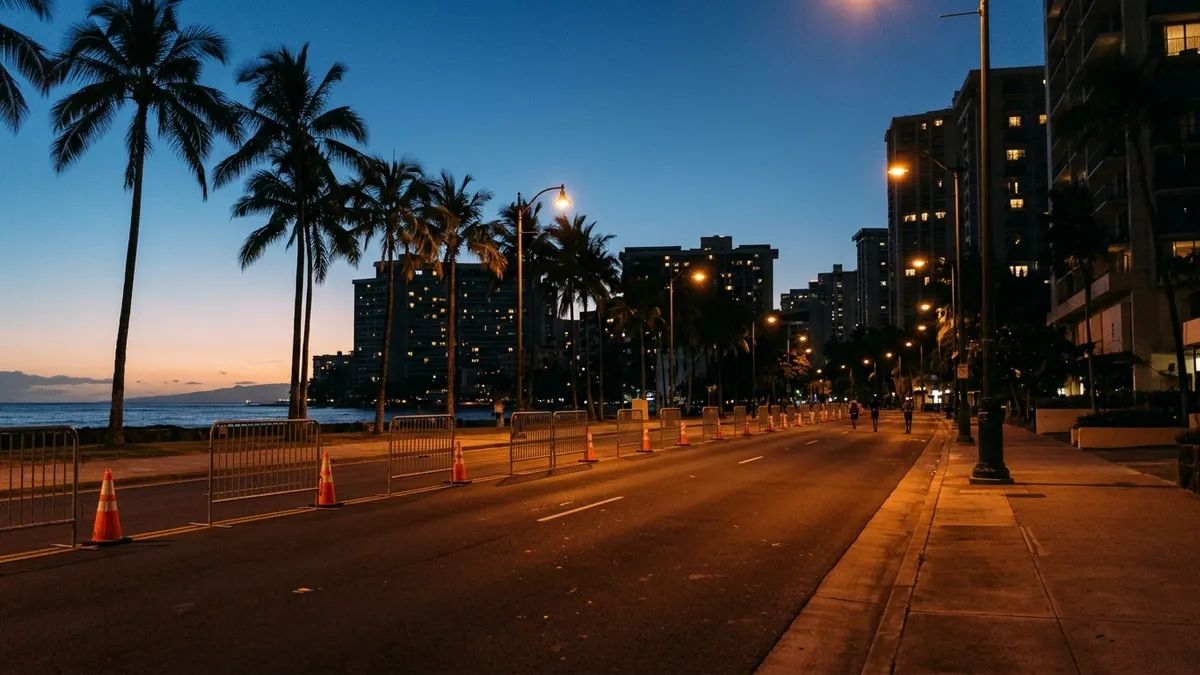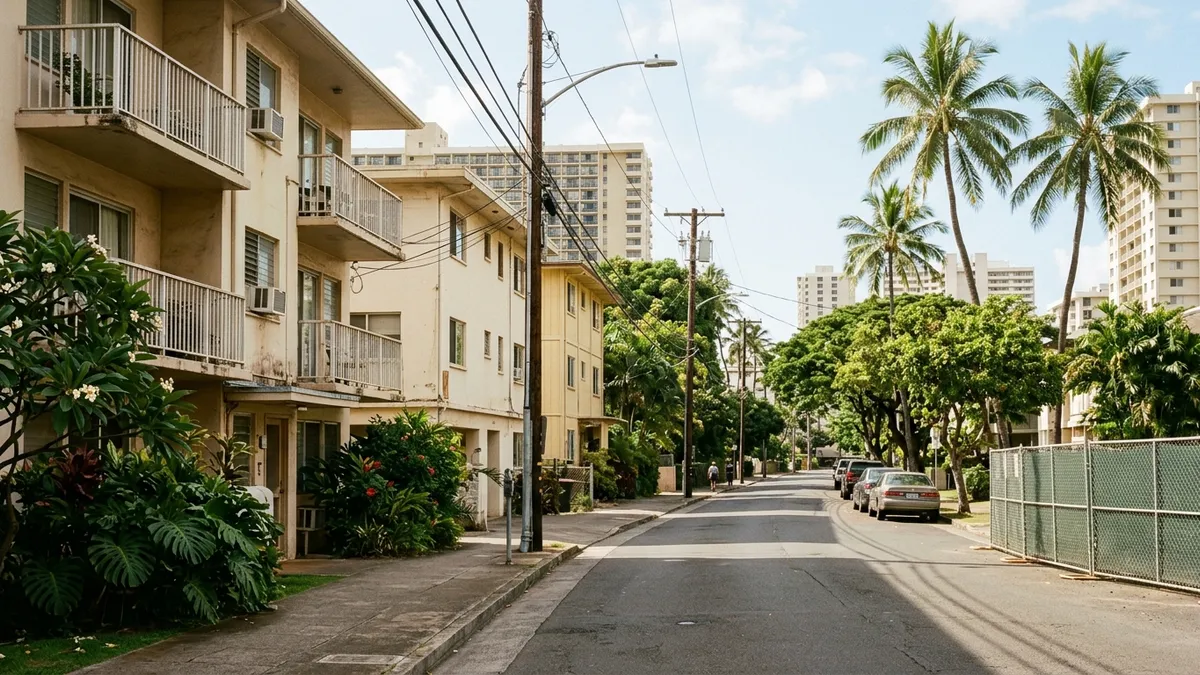
Five census tracts in Waikiki are now federal Opportunity Zones, a tax program usually aimed at struggling neighborhoods. That pairing surprised us too. Civil Beat ran the story under the headline “Does Waikīkī Need An Economic Rescue?” We read it alongside the governor’s announcement, and our short answer for anyone with a trip on the calendar: nothing about your stay changes this winter. Over the next few years, the side streets behind Kalakaua might.
What happened
On November 5, 2026, Gov. Josh Green announced Hawaii’s Opportunity Zones 2.0 designations: 25 census tracts statewide, 19 on Oahu, four on Hawaii Island and two on Maui, including Lahaina’s Front Street tract. The release says no Kauai tracts were eligible. The program, in the state’s words, “offers federal tax incentives to investors who put long-term capital into designated low-income communities.” The state says it picked tracts around three priorities: housing, clean energy, and a more resilient, diversified economy (healthcare, tourism, advanced manufacturing, agriculture, broadband and film). Maui Now carried the same list that evening.
The five Waikiki tracts, as labeled in the state’s table:
| Tract | State’s label |
|---|---|
| 18.01 | Koa Avenue |
| 18.03 | Tusitala Street |
| 20.03 | Seaside Avenue |
| 20.05 | Ala Wai-Niu Street |
| 20.06 | Ala Wai-Olohana Street |
Then on November 17, Jeremy Hay at Honolulu Civil Beat filled in the background. According to Civil Beat, the U.S. Treasury gave Hawaii a list of 88 eligible tracts and the state could choose 25. Eligibility meant a poverty rate of at least 20%, or a median family income at or below 70% of the metro area or state. The Waikiki tracts had been eligible in the first round but were selected for the first time now, and the designation lasts 10 years.
Civil Beat describes the Waikiki zones as three rough pieces: Ala Wai Boulevard to Kalakaua Avenue and Nahua Street; Ala Wai Boulevard to Kuhio Avenue between Ohua and Kaiulani avenues; and Kuhio to Kalakaua between Kaiulani and Kapahulu avenues. In other words, much of the mauka side of Kalakaua: older apartment buildings, smaller hotels, a vacant lot. By that description, the big beachfront hotels makai of Kalakaua are not in it.
Scott Glenn, the governor’s senior advisor for federal affairs, climate and housing, put the state’s thinking this way in the article: “From a tourism point of view, the hotels are needing to go through a refresh to keep up with competition. But there’s also aging housing stock there.”
What it changes for a Waikiki stay
The tax breaks belong to investors. Civil Beat lists three, all tied to capital gains: a temporary deferral on gains invested in a zone, a reduced tax on those gains after five years, and no capital gains tax on new profit if the investment is held at least 10 years. Visitors get none of that, and nothing in the state’s release or the Civil Beat piece touches what a guest pays for a room.
| Right now | Possibly, over the 10-year window | |
|---|---|---|
| Room rates and fees | No change from this designation | Renovated older hotels could come back nicer, and likely pricier |
| Construction | None announced | More fencing and work on the mauka side streets |
| What’s open | No change | Depends on which projects actually get funded |
The middle and right columns are our reading, not anyone’s announcement. Civil Beat names no specific Waikiki projects and no start dates.
How it plays out is genuinely open. Brady Meixell of the Urban Institute told Civil Beat that Ohio’s reporting data showed new housing as the main result there. David Wessel of the Brookings Institution said that nationally, “in many cases, that has been hotels rather than housing.” On Waikiki in particular, Wessel said its older hotels and apartments “might be just the place where a little bit of a tax break could provide some incentive,” and added: “I just hope they get the housing and not just the renovated hotels.”
People in the neighborhood quoted in the piece are split. Todd Ferguson, who lives on Liliuokalani Avenue, said, “As a local resident, I don’t get any tax breaks, and neither does anybody else around here.” Jason Song, who runs a shop on Kuhio Avenue, called it a good idea if the money goes toward helping the community. Civil Beat notes that Waikiki saw nearly $9 billion in tourist spending in 2024 and also has a large population of retirees and service workers with lower incomes among its roughly 20,000 residents.
What we would do — and what we wouldn’t
We would not change a single booking. This is a financing tool that starts working only when investors pick projects, and none are public. Choosing or avoiding a hotel because its block is on the list would be planning around a map, not a building.
The mauka side streets are where our grocery walks happen, so this is the part of Waikiki we would actually notice changing. If an older walk-up gets a full renovation, we would be glad to see it. If the workers who keep this town running end up with fewer places to live nearby, that is a loss for everyone, visitors included. We would rather see both happen together, and that seems to be what the state says it wants.
The practical habit we would keep: before a stay, look for posted construction notices near where you are sleeping, the same way we treated the Ena Road demolition. Daytime work a block away is fine by us. Early-morning work below your window is the thing worth knowing about in advance.
If you like the smaller, cheaper hotels on the mauka streets, nothing changes this year. If one announces a renovation later, expect a closure window and a new rate card, and judge it then.
Before you plan around this
- Only the designation is official. No Waikiki projects, timelines, or closures have been announced in the sources we read.
- The 10-year length and the three tax benefits come from Civil Beat’s reporting; the state’s release does not spell them out.
- The state cannot pick which projects get the break. Gwen Yamamoto Lau of the Hawaii Green Infrastructure Authority told Civil Beat, “We cannot stop investors from doing what they want. But we can encourage investors in things that are important to us.”
- The full federal list and map are on the CDFI Fund’s Opportunity Zones page, as the governor’s release points out.
We checked all of this on November 18, 2026. When the first Waikiki project shows up, that is the news that will actually touch a stay.
This is a visitor’s reading of public reporting as of November 2026, not tax, investment, or legal advice; verify current rules with the U.S. Treasury and a tax professional.